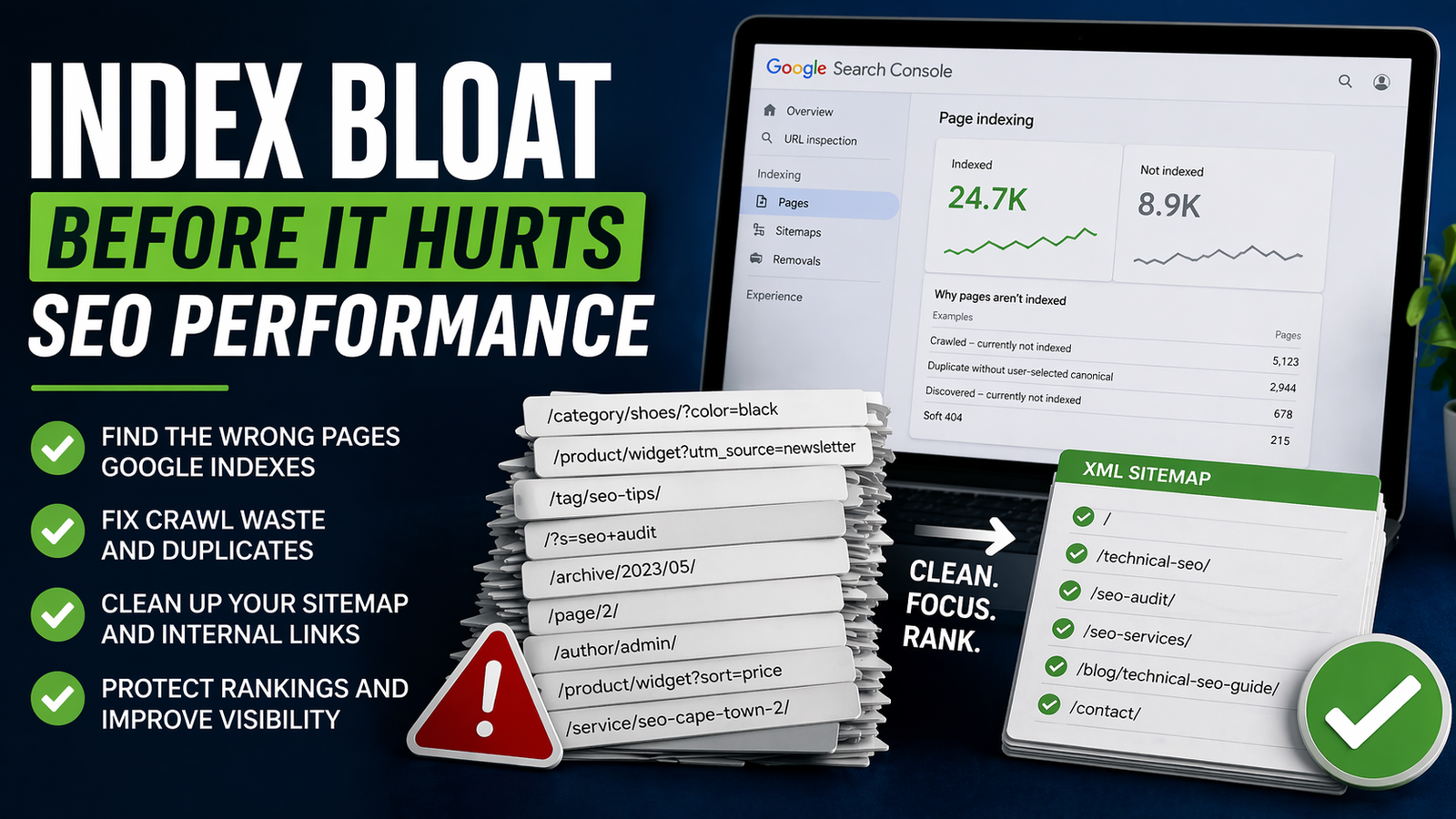
To find index bloat, compare the URLs Google has indexed with the URLs that genuinely deserve to rank. In practice, that means checking the Page Indexing report in Google Search Console, comparing it against your XML sitemap, crawling the site, and then making a few hard decisions: which URL groups should stay indexed, which should be noindexed, which should canonicalise, which should merge, and which should disappear behind redirects.
This matters because index bloat is not really a size problem. It is a standards problem. Once Google has to sort through too many archive pages, parameter-driven URLs, stale campaign versions, and near-copy pages, its choices start getting worse. By the time rankings make that visible, the site has usually been losing clarity for months.

What index bloat is
Index bloat happens when search engines index more URLs than your site needs in search.
A large site is not automatically bloated. A retailer with thousands of well-managed product pages can have a healthy index. A much smaller site can still be bloated if it lets accidental, repetitive, or low-intent URLs into Google’s view of the site.
Typical examples include /category/shoes/?colour=black&size=9, /tag/technical-seo/, /?s=seo+audit, /product/widget?utm_source=newsletter, and /service/seo-cape-town-2/.
The issue is not that these URLs exist. The issue is that they often become indexable without anyone ever deciding they deserve to compete in search.
Why index bloat matters
Index bloat makes it easier for Google to choose badly.
That is when a filtered category URL appears instead of the main category page, a thin archive shows up where a service page should rank, or a duplicate page starts competing with the version that should have won by default.
This rarely looks dramatic at first. It feels more like drag. Signals blur. Reporting gets harder to trust. Strong pages take longer to settle because the site keeps putting weaker options in front of Google. What looks like technical housekeeping is often a commercial problem: the URLs carrying your business stop being the clearest options in the set.
Index bloat is not the same as crawl bloat, duplicate content, or cannibalisation
These problems overlap, but they are not interchangeable.
Index bloat means too many low-value URLs are actually indexed.
Crawl bloat means search engines spend time crawling too many URLs, even if many never enter the index.
Duplicate content means multiple URLs contain the same or near-identical content. That can contribute to index bloat, but it is only one route into the problem.
Cannibalisation means two or more pages compete for the same intent. That can happen because of index bloat, but it is fundamentally a targeting problem, not just an indexing one.
The distinction matters because the remedy changes with the diagnosis. Crawl issues may need crawl controls. Duplicate issues may need canonicalisation. Cannibalisation often needs consolidation or retargeting. Index bloat is about what has been allowed into the index that never earned the right to represent the site in search.
The workflow to find index bloat
Start with Google Search Console’s Page Indexing report
Open Indexing > Pages in Google Search Console.
Do not use this report as a scoreboard. Use it as a map of recurring URL behaviour.
You are looking for URL types that should not be indexable at scale: parameter URLs, tag pages, internal search pages, legacy folders, and thin template-generated pages. One strange URL tells you almost nothing. Fifty URLs with the same structure tell you where the trouble really begins.
If you click into a bucket and keep seeing /tag/, ?sort=, ?colour=, /author/, or /?s=, you are not looking at isolated mistakes. You are looking at a publishing system that keeps creating pages nobody consciously chose.
How to read Page Indexing statuses in the context of bloat
The labels do not diagnose bloat on their own. The URLs inside them do.
Duplicate without user-selected canonical
This usually means Google found multiple similar URLs and had to choose for itself. If the bucket is full of campaign duplicates, overlapping service slugs, or parameter-heavy versions of the same page, that usually points to structural sprawl. The site created too many competing versions and never made the preferred version unmistakably clear.
Alternate page with proper canonical tag
This is not automatically a problem. Sorted product lists, filtered category views, or tracking variants may need to exist while correctly pointing to a main URL.
The real judgment call is scale and necessity. Ten alternate URLs with clean canonicals may be harmless. Ten thousand is different. A correct canonical does not turn avoidable duplication into good architecture. It simply tells Google which version you prefer after the excess already exists.
Crawled – currently not indexed
This is often one of the clearest warning signs on bloated sites. It can mean Google saw the page and decided it was not worth indexing. If the bucket contains tag pages with no substance, repetitive local pages, or near-duplicate article variants, Google is effectively telling you the site is publishing more indexable material than it can defend.
This bucket is not always bad. New pages and recently improved pages can sit here temporarily. The warning sign is recurrence. If the same flimsy structures keep showing up, that is no longer a delay. It is a quality problem with an architectural cause.
Discovered – currently not indexed
This often points to excess volume or weak crawl prioritisation. If the bucket is full of filter combinations, auto-generated archive pages, or other low-priority structures, Google is finding more URLs than it wants to invest in.
A small number here is normal. A large inventory of trivial URLs here usually means the site is generating far more discoverable pages than it can realistically support.
Soft 404
This can indicate pages that technically return 200 status but do not look like meaningful documents. If this bucket is full of near-empty category extensions, shallow local variants, or bare template pages, that usually belongs to the same broader bloat story.
The useful question is never just “what is the status?” It is “what kinds of URLs sit inside this status, and did those URLs ever deserve to exist in this form?”
Compare Search Console against your XML sitemap
Your XML sitemap should be your cleanest statement of intent. It should list the canonical URLs you actually want indexed.
Export the sitemap URLs and compare them against the page types appearing in Search Console. A common mismatch looks like this: the sitemap contains service pages, category pages, product pages, and strong articles, while Search Console shows indexed URLs such as /?s=technical+seo, /tag/shopify/, filtered category URLs, or product URLs carrying campaign parameters.
That gap is the story. Google is indexing more than your intended landing-page set.
A sitemap will not control the index by itself, but it does reveal whether your intended architecture and Google’s observed behaviour are drifting apart. When those two pictures stop matching, the cost is rarely abstract. Authority, crawl attention, and search visibility begin drifting toward URLs that were never supposed to do the selling.
And that is where the work changes. You are no longer describing untidiness. You are measuring wasted SEO capacity.
Crawl the site and sort URLs by type
Now move from suspicion to proof.
Run a crawl and group URLs by type: folder structure, parameter usage, page type, indexability, canonical target, status code, and internal inlinks. This is where the diagnosis stops being a hunch and becomes evidence.
It is the difference between saying “the site feels cluttered” and saying “we have 480 crawlable tag pages, 1,200 parameter-driven URLs returning 200 status, and 70 attachment pages receiving internal links.”
That difference matters. Vague concern rarely produces structural fixes. Evidence does. Once the numbers are visible, what felt like a mild technical nuisance starts looking like what it really is: a site producing pages faster than it can justify them.
Check whether the site keeps promoting the wrong URLs
Pages do not stay prominent to Google by accident. They stay prominent because the site keeps surfacing them.
Review internal links to the URL groups you already suspect are causing trouble. Look at filter controls, related-post modules, archive templates, breadcrumbs, footer links, and CMS defaults. If repetitive or low-value URLs keep receiving internal links, the site is repeatedly telling Google they matter.
This is the point many teams miss. Index bloat is rarely just an indexing problem. It is usually a site-architecture problem in disguise. Google is often following the signals the site itself keeps sending. In other words, the site is teaching Google the wrong lessons and then wondering why the exam results are poor.
A few site: searches can help as a sense check here, but only as backup. They are useful for confirming suspicion, not for making decisions.
Turn the diagnosis into decisions
Once you know which URL groups are causing the problem, decide what each one needs.
Keep a URL indexed when it has clear search value and deserves to rank on its own. Noindex it when it helps users navigate the site but has no business appearing as a landing page. Canonicalise it when multiple versions need to exist but only one should collect ranking signals. Merge it when several thin pages are trying to do the work of one strong page. Redirect it when the weaker or outdated URL no longer needs to exist.
That is the step shallow advice usually skips. Finding bloat is only half the task. The real value comes from matching the right remedy to the right kind of excess.
What to fix first
Fix the URL groups creating the most waste, not the pages that happen to irritate you first.
Start with parameter-heavy and filter-driven URLs because they usually create volume fastest. Then deal with internal search pages, archive pages with no real standalone value, overlapping variants, sitemap pollution, and the internal links that keep weaker sections alive.
The decision logic matters more than the order. Noindex pages that are useful onsite but poor search landing pages. Canonicalise alternate versions that genuinely need to exist. Merge pages that overlap so heavily that none deserves to stand alone. Redirect pages that are obsolete or replaced.
A common failure mode is using one blunt tool for every problem. Teams noindex pages that should have been redirected, canonicalise pages that should have been merged, or leave duplicates live because “Google will work it out.” That is how index bloat survives multiple cleanup rounds and quietly becomes part of the site’s normal state.
Edge case: when paginated or canonicalised URLs are acceptable
Not every non-primary URL type is a problem.
Paginated URLs can be perfectly reasonable if they are a natural part of a large category or archive and are not pretending to be unique landing pages. Large sets of canonicalised parameter URLs can also be acceptable if those URLs genuinely support browsing and the site keeps them under control.
The key question is whether the site is generating these URLs as a sensible by-product of navigation or spraying them across the architecture as if they deserve independent visibility. Some controlled duplication is normal. Uncontrolled duplication at scale is where bloat begins.
Mini-case 1: faceted ecommerce URLs
Imagine the main category page is /laptops/.
That page deserves to rank.
Now the CMS also creates /laptops/?brand=lenovo, /laptops/?brand=lenovo&ram=16gb, and /laptops/?brand=lenovo&ram=16gb&sort=price-low-high.
In Search Console, these filtered URLs appear in indexed and duplicate buckets. In the crawl, they return 200 status and attract internal links from filter controls. They are absent from the XML sitemap.
The diagnosis is straightforward: the category page has search value, but the filtered combinations are being exposed as if they deserve to rank independently.
The action is equally straightforward: keep /laptops/ indexed, canonicalise or noindex the filtered variants depending on site needs, and review the filter-link behaviour so the system stops producing unnecessary indexable combinations.
Mini-case 2: blog tag archives on a content site
A site publishes strong technical SEO articles. It also has tag archives such as /tag/canonicals/, /tag/indexing/, and /tag/google-search-console/.
Each tag archive contains one or two posts, a weak intro, and no meaningful editorial value. In Search Console, these pages sit across indexed and crawled-not-indexed buckets. In the crawl, they return 200 status, appear in sidebar widgets, and are included in the sitemap.
Again, the diagnosis is not subtle: the site is turning internal organisation into public landing pages without earning it.
The fix is to keep the strong articles indexed, noindex or de-index the thin tag archives, remove them from the sitemap unless there is a real case for keeping specific ones, and stop promoting them through template links.
This is one of the most common non-ecommerce forms of index bloat, and it usually comes from CMS defaults rather than deliberate SEO thinking.
Where index bloat usually starts
Most index bloat begins the same way: the site generates URLs faster than it justifies them.
Sometimes that comes from faceted navigation. Sometimes it comes from CMS defaults exposing tags, authors, dates, and attachment pages without much thought. Sometimes it comes from weak governance, where old campaigns, thin pages, and legacy URLs are left to accumulate. Sometimes it comes from template-level duplication that produces too many versions of essentially the same page.
The label matters less than the behaviour. If the system keeps producing second-rate URLs, the index will keep filling with second-rate choices.
Signs index bloat is already affecting performance
You usually notice it in page selection before you notice it in rankings.
Google starts surfacing weaker URLs instead of the page you intended to rank. Duplicate or low-priority pages remain indexed while important pages stall. Similar pages keep competing for the same queries. Crawl reporting shows repeated attention on URL groups you would never have chosen as landing pages. Page-level analysis becomes harder because too many unnecessary candidates remain in play.
That is not just untidiness. It is a loss of control over which pages represent the site in search.
Final takeaway
Index bloat is not really a page-count problem. It is a page-quality problem with search consequences.
A site can have thousands of indexed URLs and be perfectly healthy. Another can have a few hundred and still be bloated if too many of those URLs are accidental, duplicative, or too thin to deserve visibility. The real risk is not scale on its own. The real risk is giving Google too many poor options and then wondering why the wrong page keeps getting chosen.
That is why the job is not “reduce the number of indexed pages.” It is improve the quality of the pages competing for visibility in the first place.
Start with Search Console’s Page Indexing report. Compare it against your sitemap. Crawl the site. Group URLs by type. Check internal links. Then assign a real action to each set.
Once you do that, index bloat stops being a vague technical complaint and becomes a solvable quality and architecture problem.
Leave a Reply